


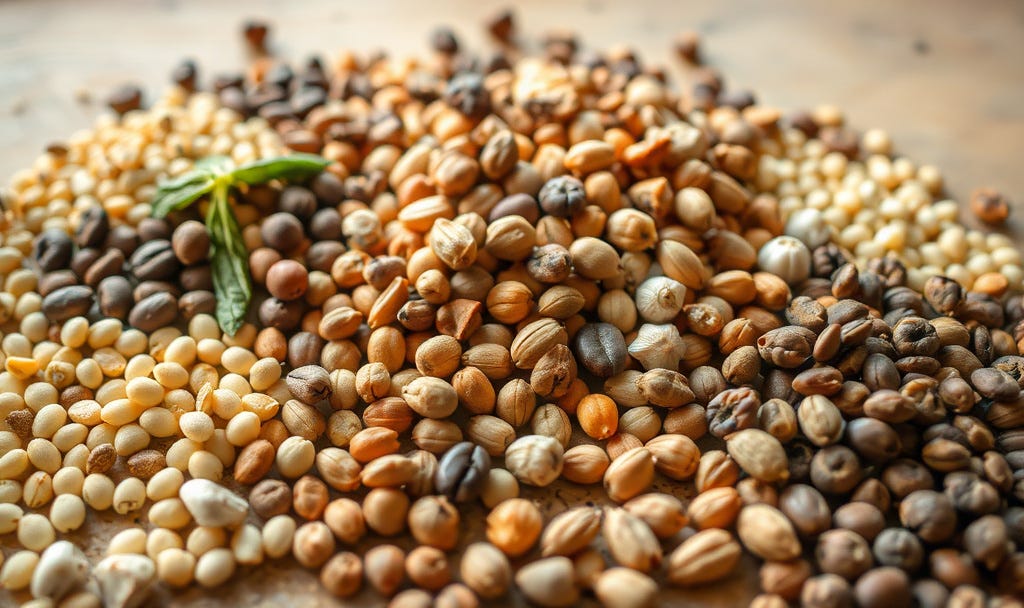
Over the course of nearly six decades of gardening, I’ve learned one or two things. For example, most flowering plants produce seeds. And those seeds usually germinate and grow. And those are seeds are… how shall I put this? Right. Free.
Hmmm. Let’s just say that I save a lot of seeds.
I do buy some seeds — I’ll get to that in a bit. But a lot of what I grow is from saved seed. Before I inevitably get all philosophical on you, here are a few select epiphanies that I’ve gratefully welcomed into my life over the years of saving seeds rather than buying them.
Take the Pepper.
If you like to grow peppers — at least the common types — there is no point in buying pepper seeds. Pro tip: Buy a pepper instead. I know, I know, this is shockingly brilliant — what can I say <blows on fingernails>. Just about any pepper that you buy in a grocery store will have viable seeds. And those seeds will produce wonderful plants that produce a lot of peppers. Commercial peppers are not like commercial tomatoes, which are bred by frustrated mechanical engineers for structural integrity. Don’t grow those, unless you prefer blobs of cellulose, masquerading as tomatoes, that conjure memories of tasteless three-packs wrapped in cellophane at the A&P circa 1975.
But purchasing pepper seeds inside a paper packet rather than inside a perfect pepper is for perfunctory pedants. Bell peppers… little lunchbox peppers… jalapenos …if it’s in the grocery store, just buy the dang pepper and set aside some seeds. Here’s my highly advanced calculus on the matter: You can spend four bucks on a packet of peppers seeds, which will typically grow only one color. OR… You can spend that four bucks on a multi-floral bag of sweet lunchbox peppers, have a nice bonus salad now, plus more peppers than you know what to do with next July. Clearly, Big Pepper has been covering this up for decades. But as Neo said in The Matrix, “I’m going to show these people what you don’t want them to see.” That said, I hope some wobbly-headed dude in a dark suit and sunglasses doesn’t appear out of nowhere to kick the crap out of me. I’m a man of peace.
Before you start sending me nastygrams, I do understand that some of you are the highfalutin, fancy-pants, boutiquey Brooklyn types who need to grow this or that rare hybrid poblano for an artisanal salsa that you pair with a rare whiskey from some sketchy basement in Tennessee. God bless you. But I’m not talking to you. My dad was a plumber. I pickle working class peppers for capicola (“gobbagool” in New Jersey) and provolone sandwiches. Capisce? (“Gabeesh” in New Jersey).
But seriously, there’s nothing wrong with buying overpriced pepper seeds for obscure specialty varieties that you like. All I’m sayin’ is, if you can find those seeds inside a pepper somewhere… take the pepper.
It’s the Great Pumpkin. Not.
Let’s toss winter squash and cantaloupes and honeydews (oh my) into the mix too. Whether we’re talking pumpkins or butternut squash or acorn squash or summer melons or whatever, they all have one thing in common: They are promiscuous little buggers that reproduce like rabbits. You know this already because you have undoubtedly seen what lurks inside these exquisitely packaged bundles of curcurbit joy — lots and lots of seeds. And you know what? Virtually all of those seeds are viable (except for cucumbers, but we’ll get to that). And yet we trip over ourselves running to the trash can, as if what’s nestled inside these round mounds of wondrous flesh is a wretched plague. I weep. Oh blessed curcurbits, how many years have I wept over your trauma, as your children are discarded like half-eaten hors d’oeuvres over the rail of a kitschy cruise ship. Give me your tired, your…
Sorry, I lost control of myself there. This is an emotional subject.
Admittedly, the argument for saving squash and melon seeds can be slightly less compelling than the argument for peppers. Why? Because the metasquashverse teems with infinite variations on its basic themes. Plant breeders have developed a lot of exotic varieties that you might find interesting. Some very weird people actually spend their lives developing better butternut squash. I’m not sure that I’d want to know those people — I bet they are a blast at parties. But I do say a little prayer for them every day. God bless horticultural nerds. We need such dedicated souls. And if you really need the deepest butternut color and flavor, fine — go buy expensive, artisanal squash seeds from some university lab with an online storefront. But if you’re okay with the basic archetypes of classic squash and melons, the seeds from a store-bought fruit will do the job just fine. You can’t beat the bold flavor of a ripe heirloom muskmelon. And pumpkins are pumpkins — i.e., they’re fun to grow, and they look nice on your front stoop for a few weeks, before they rot and you shoo them away in favor of blow-up Santas and creepy reindeer mannequins. Saved seed is fine for this application. Trust me, if you want to make a pie, the stuff in the can at the grocery store is easier and cheaper than buying boutique pumpkin seeds.
Beans, Beans — the Musical Fruit
I haven’t bought a packet of bean seeds in a looooong time. Unlike peppers, bean seeds aren’t the best as free bonus buys from the supermarket — like cucumbers, beans are generally picked and sold before the seeds fully mature. But all is not lost. Because beans that you grow in the garden are the easiest seeds in the world to save. You just let a few pods grow to maturity and dry out on the plant, and then store them. That’s it — next season’s beans, reporting for duty. You can do the same thing with cucumbers; just let one of the larger, robust fruits overdevelop toward the end of the growing season. Then follow the tomato procedure outlined below.
Mustard Rocks. Unless You’re Pregnant.
If you’ve ever grown kale or mustard or arugula or any number of other plants like them (e.g., canola — yes, that canola!), you have probably noticed that they all produce similar seed pods. And, of course, there’s a good reason for that. Over many centuries, they were all bred from ancient mustard. Mind blown. I’ll give you a moment to recover…
…as an aside while you’re adjusting, don’t ever boil garden mustard greens if there is a woman in the house in her first trimester. No, it doesn’t cause birth defects. But the aroma does induce vomiting. I won’t tell you how I know this. Ladies and gentlemen, just know that I will always have your back with years of hard lessons.
Anyway, all these vomit-inducing Brassicaceae are cousins. And they all go to seed like crazy. Just let one plant go to seed, pick and dry the pods, and you’re set for next year. In truth, I am underselling them a bit, as seeds from this family also tend to last a long time — seven or eight years if you simply avoid abusing them with heat and light, longer if you put them in cold storage. At least that’s what people claim. Personally, seven or eight years is more than enough for me.
Those are a few prominent examples. But I save all sorts of seeds — tomato, eggplant, sunflower, cilantro, dill, basil, zinnia, kale, arugula, mustard, spinach, among others. In fact, even my fifty year-old grapefruit tree started life as a couple seeds from a grapefruit in my parents’ refrigerator. You can read about it in Chapter 1 of my online book.
With all apologies to Billy Dee Williams, seed saving doesn’t work every time. But it works a lot. Still, I feel obligated to point out a couple pitfalls. Here are some issues to consider:
Genetic Drift
That’s a sloppy, inaccurate term in this context, but it sounds cerebral, so I choose to use it anyway. For better or worse, if you save seeds every year, and are always in a rush like I am, over time you will likely develop your own plant variety. Which in one sense is a cool little ego trip, but in another sense is failure. This has happened to me with beans.
I planned to buy a new packet of bean seeds for this season, for the first time in at least a decade. Why? Well, I started with seeds of my favored haricots verts variety. These are a thinner, more delicate kind of green bean. Over the years of careless seed pod selection on my part, my beans now look a lot more like standard green beans than the snobby kind that I (and my 15 pound schnoodle Hazel) prefer. It’s not the end of the world, but I think it’s time to start anew with a fresh batch of seeds. Fortunately, my daughter gave me some new haricots verts seeds for Christmas, saving me the embarrassment of admitting defeat. But it was a nice run, and I probably saved thirty bucks.

F1 Hybrids
Q: What’s an F1 hybrid?
A: A seed that comes in a packet that costs eight bucks and has ten seeds in it.
Well, that’s the practical answer. The real answer is that F1 hybrids are precisely-bred combinations of two plant varieties that have desirable traits, which magically produce something even greater. They require a lot of expertise and labor to create, which is why you pay dearly for each seed. Sometimes it is worth the investment, other times not so much. But there’s a catch. F1 hybrids are the temperamental artists of the plant world, unconcerned with the practical joys of life — like, you know, reproducing. Their offspring are mostly ne’er do wells that lack their parent’s genius and can’t be trusted.
So you can’t save seed from F1 hybrids, unless you’re doing it for fun and/or have a kind of morbid, macabre, H.G. Wellsian side that likes mutants. Results will range from total failure, to something weird, to (very occasionally) something interesting. That last possibility can be fun to explore, if you have the time and space. But, generally speaking, hybrids and seed saving don’t mix for gardeners who prefer fresh vegetables over the deep joy of experiments gone terribly wrong.
Of course, I’m one of those gardeners who enjoys a good experiment gone wrong. And it turns out that I conducted a few badly designed and poorly executed experiments on seeds from hybrid tomatoes last season. If you must know, that was the original intended subject of this post. But I got so off track so early that I decided to cover that odyssey in a separate post, coming soon to subscribers only.
Seed Prep and Storage
If you want your saved seeds to hang around until next season rather than get moldy and find their way to the trash by December (with the pumpkins on your front stoop), you do need to respect one or two basic principles. But take heart, this is not the neurosurgery or quantum physics that some people want to make it. In the end, you just want really dry seeds. They can even have some schmutz. What, you think that schmutzy seeds don’t grow in the wild? Of course they do! Just be sure that any schmutz is dry schmutz. I mean really dry, not just dryish. Dryish won’t do. You need bone dryyyyyyy.
For some seeds, this is mindlessly simple. For say, mustard family, here’s the super complex procedure: (1) lop off a few branches with seed pods, (2) tie the pods together with a string and hang them somewhere in the garage, (3) forget about them for six months, (4) rediscover them in the fall when you’re cleaning up the garage from a summer of neglect, (5) choose to disregard your spouse’s plea to throw them in the trash because they’ve been shedding everywhere, and (6) swear at yourself for not labeling the mustard and arugula, since they look exactly the same when they are dried out. “Because they’re coooousins, identical cousins and you’ll find…” (if you clicked, sorry, I had to do it).
Legal disclaimer: I take no responsibility for the consequences of (5). You can avoid (6) by labeling. Labeling is one of the top five boring garden skills that will improve your standing as an effective and fully actualized human. Sadly, obituary writers for great gardeners never write about what great labelers their subjects were back in the day. But they should. Because labeling matters. I even apply database design theory to some of my labeling, that’s how into labeling I am. Sexy, I know. But that’s a subject for another time (I mean smart labeling, not my irresistible manly musk). For now, just remember to label your saved seeds while they are drying. You’re welcome.
So you say “Okay, smartypants, that’s easy. But what am I supposed to do with slimy tomato seeds, huh?” Well, it’s simple, way simpler than what the OCD seed savers out there want you to believe. Here’s what you do:
Slice open a nice non-hybrid tomato, and squeeze the seeds into a kitchen sieve.
Rinse the seeds over the sink in the sieve. Perfection is unnecessary. There will be schmutz. Embrace it. Let the seeds drain for an hour or so.
Label a paper napkin with a Sharpie.
Spread the seeds out onto the napkin.
Place the napkin on a plate and put it somewhere where your spouse won’t toss it because he or she wants the plate back.
Forget about it for a couple months. Will a week or two suffice? Maybe. But why risk greatness?
So you say “That’s nice, now I have dried, schmutzy seeds glued to a paper napkin. Brilliant!” To which I say “You misunderstand my zen genius, grasshopper, please take a chill pill.” Granted, you do have dried, schmutzy seeds glued to a paper napkin. But take the win, Francis! Just grab a paring knife and pry a couple dozen seeds off. If some schmutzy dried napkin residue comes along for the ride, I’m here to tell you, in my best Bill Murray voice, it just doesn’t matter! If anything — and this is a totally unsubstantiated theory that I am plucking from the collective consciousness of the universe as I type — the dried napkin residue will likely wick water toward the seed when you plant it, enhancing germination. So there.
And, finally, storage.
Seeds that aspire to longevity hate three things: excessive heat, moisture and light. You can take care of the last two by rolling your own seed packets out of aluminum foil. You know all those snarky memes about tin-foil hat-wearing conspiracy types? Well, unfortunately, most of them are accurate. But they do mask a convenient truth, which is that metal foils actually do shield against electromagnetic radiation. Like light, for instance. But modern homes are also bathing in a sea of similar radiation, none of which is particularly great for seeds. Seed companies pack sensitive seeds in foil for a reason.
If I had a cool video of me making such a packet, I would insert it here. But I have no such video. I might be the worst bespoke seed packet maker in the gardening world. But, again, the Murray Rule applies — it just doesn’t matter. Just grab some Scotch tape and something like an 8x10 sheet of aluminum foil and start folding. You’ll figure it out. Just make sure that you end up with a pocket and a flap. Masking tape makes a nice label.
As for the excess heat thing, a cool basement with fairly constant temperature is a fine location to store seeds. Most garden seeds don’t require stratification, so you really don’t need to gobble up freezer or fridge space. A shoe box with a lid will do nicely.
I guess it’s time to wrap this up. Sadly, I never got distracted into a philosophical tangent this time, unless you consider the Patty Duke theme song philosophy. But, hey, Cathy adores a minuet, the Ballets Russes, and crepes suzette. It’s hard to compete with ideas at that depth. But maybe these words from my book will at least get you thinking…
Ah, seeds. Did you know that the watermelon seeds that, as a kid, you casually spit to the ground at picnics are actually miracles of information processing, more sophisticated than the most complex hard drive or cloud storage location? (yes Virginia, real watermelons have seeds…) Inside that watermelon seed is the full instruction set for making a ten-pound watermelon in about a hundred days (which itself will contain a few hundred reasonable facsimiles of those instructions buried securely within). Those instructions include the whole lifecycle – from what to do when moisture enters the hull of the seed, to developing a tiny root and stem (including which direction each should grow), to all the short-term metabolism required to kick start that whole procedure.
From there it knows how to shut down all those early processes and quickly transition to a photosynthetic system – itself an encyclopedia of chemical complexity – all while the root system supplies just what is needed, at exactly the right time, to support the requisite plumbing. It can then go into cruise control for a couple months, somehow knowing that it isn’t time to make any watermelons just yet. Of course, “cruise control” includes all the knowledge needed to build an exquisitely engineered root and stem substructure, magically designed for growing watermelons. And, on cue, somewhere along the way the “I feel like a grown up” gene kicks in and, presto, all the instructions for building a flower activate.
Have you ever tried to build a flower from water, carbon, nitrogen, potassium, phosphorus and some trace minerals? Don’t feel bad. Nobody on earth knows how to make a flower from scratch, let alone one that is precisely engineered to appear at exactly the right time, uniquely equipped to attract insects, able to ensure that the plant can regenerate in roughly the same shape, size and chemical composition next year. But why should a watermelon plant care if it produces a watermelon? Would a pepper not do? Or an eggplant? Somehow it only knows how to make watermelons. And an eggplant plant only knows how to make eggplants.
And of course, at some point that flower gives way, almost in a flash, to a small green berry thing, attached to the plant by a little stem that somehow knows how to bulk up to support what that tiny berry will become in a few short weeks. And the berry has an incredible containment and home defense system that manages to keep itself intact while expanding from a BB to a basketball. And, finally, having reached a certain size through the wonders of chemistry and extraordinary plumbing, and having built a few hundred information bombs nestled safely within, each with an information density far beyond any computer’s, each capable of repeating the whole process anytime in the next few years, the finished watermelon knows that it must transform itself into something appetizing, both for its own good and for the good of everything around it.
All of that know-how is locked within that tiny seed. And, not surprisingly. nobody has the first clue how to build one.
I say, embrace the miracle for what it really is.
I'm guessing the schmutz contains endophyte spores that keep the developing plant healthy and ultimately end up in our gut keeping us healthy. Hell, they might be the secret ingredient in your septic tank fertilizer.