


I didn’t go to kindergarten. Maybe this explains a lot, difficult to say. I did spend the next eight years in a Catholic elementary school that didn’t know what to do with me. My parents were all but non-practicing; my mom would always say that we were in Catholic school for “the discipline”, although I suspect the real reason was pressure from the preceding generation. I can understand that to a point. But the main point of education is education — and, as we will see, edification. For eight years I would finish the assigned work in a few minutes, and then spend the remaining time with my head down, exploring the finer nuances of discipline and self-control, per instruction. Then I would go home and figure out new and better ways to feign illness, so that I could spend the next morning in my pajamas watching Ultraman in black and white on fuzzy UHF channels, rather than napping in a jacket and tie. If you too spent your childhood admiring Ultraman, check him out in color on YouTube. Mind blowing.
Catholic school wasn’t all bad. I learned to read long before first grade, so my lack of kindergarten was no impediment to hitting the ground running, academically speaking (after a hard landing, that is — it took a couple weeks for them to realize that I couldn’t see the blackboard, and for me to realize that there was something there to read). I was thrilled when I learned that one of our core books was called a “reader”. Sure, the texts were artless and unsophisticated to a kid who liked to open ancient encyclopedias to random pages and read whatever appeared. But they were stories that appealed to kids — in contrast to say, entries on light subjects like antidisestablishmentarianism.
One later story that I particularly liked centered on a kid who liked to invent things. I think his name was Alvin. He might have been a popular serial character, but don’t quote me. I knew him only from a couple stories in the reader. Alvin had a problem with his alarm clock. I could relate, though my “alarm clock” was my mother banging the floor from below with a broomstick. Alvin decided to strap the clock to the bedpost and rig a string to the bell mechanism, with the other end of the string attached to his big toe. When his revised alarm triggered, it would yank on his toe rather than make a noise. I can’t remember if it worked, but I do remember my reaction, which was a kind of jealousy strapped to resolve. I wasn’t planning on tying a string to my mother’s broom. But the notion of building solutions to difficult problems appealed to my six year-old brain.
We had recently moved from the reproductively friendly confines of Levittown, PA to a new house raised over an ex-swamp in a nearby borough. The “lawn” was still weedy clay, and it had been raining a lot. Which was a problem that I invented, given that we had a perfectly good sidewalk. I decided that we needed a bridge over the lawn, preferably one with a toll booth so that I could charge the paper boy an admission fee. So the next day I found a couple boards and a hammer and started pounding them into the ground on the driveway side of the lawn. Sadly, I had no plan for what to do next. I stood there, a short length of an old 2 x 6 at my feet, one end sorta kinda stuck in the mud. After a few minutes in the cold and dreary air, with no next step even remotely visible over the horizon, I quietly abandoned my mercantile fantasy, leaving the materials in place. Cleaning up the worksite would have admitted defeat, which was unthinkable. But the yearning to build remained in my soul and bones.
A couple years later I decided to redeem myself. I was bored and found myself once again rummaging through spare ends of wood in my parents’ utility room — mostly small lengths of 2x10 and millwork that you find in the garages of tool owners. And for some reason I decided to build a shelf. I can’t explain it. I didn’t need a shelf at the time — I was eight or nine years old, and shared a small bedroom with a much older sibling who ruled with an iron fist. There was no place for a shelf. But I was determined. Failure was not an option this time. So I built a shelf, which, for reasons that only the Lord above knows, I still own. Here it is:
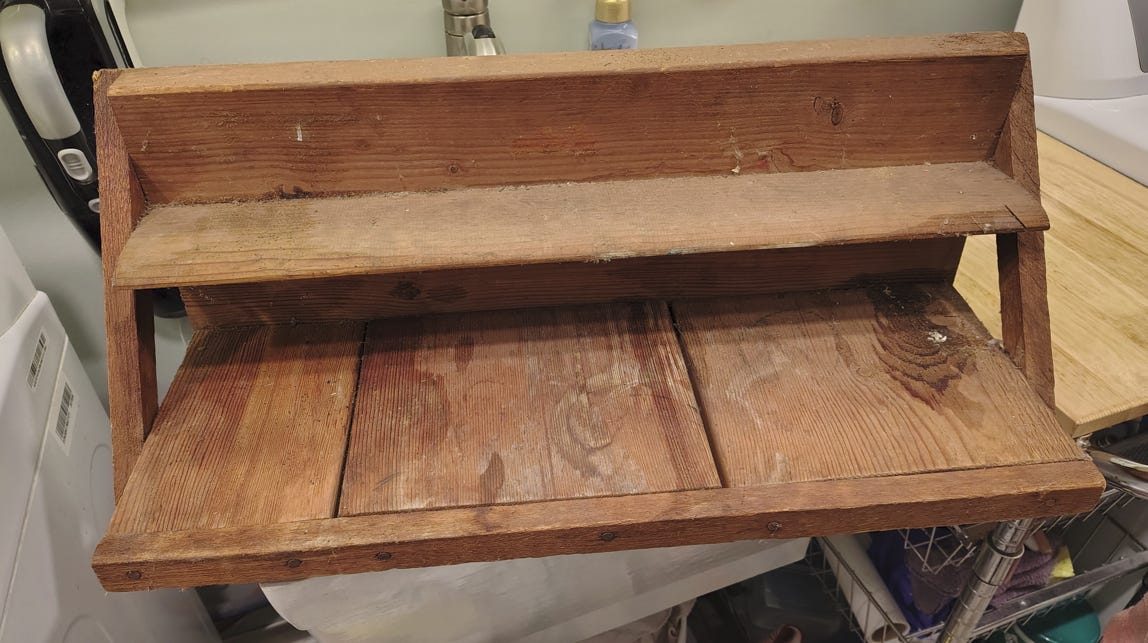
I recall a peculiar moment that evening when my father noticed my handiwork (maybe a first in my life to that point). I winced. I was sure the inevitable explosion was coming my way, something like “What the hell were you thinking? That’s good wood! Why the hell do you need a shelf???” But nothing like those words crossed his lips. He hesitated for a moment, stared at my masterpiece for a moment longer, and said, “Did you make this?” in an unnervingly gentle voice that betrayed genuine curiosity. I think he was impressed. I mean, he would never admit it, but he was clearly allowing himself the briefest of serene moments, entertaining the notion that this geeky, pencil-necked, candy-ass, sixth kid of his might be salvageable.
I probably should have taken the win, stopped there, accepted that building things would remain one of the dozens of mediocrities that would define my husky and broad but frighteningly shallow skill set. And then resigned myself to a respectable life of number crunching. Or at least something with retirement benefits. But no. As puberty hit, all of that self-control stuff from Catholic school evaporated like dew in a desert. The implacable urge to build would not be denied.
One of the great rituals of youth in areas with a lot of new construction is the fine art of — how shall I put this? — “long-term borrowing” of materials from construction sites. I learned the craft well, and I learned to rationalize it even better. You see, I wanted a clubhouse. And my clubhouse was so important that any self-respecting home builder would surely want to donate materials to this worthy cause. Thus, there was no need to ask.
As the materials “materialized”, my ambition soared with them. This would be no kiddie shack. I scoped out how they built the houses that were generously underwriting my worthy cause, and I modeled my design accordingly. First there would be a foundation; four “donated” cinder blocks would do nicely. Then there would be a platform of 2x6’s and plywood. Then proper, framed walls would rise, and, eventually, a roof. But I never got to the roof. Or the front wall. My clubhouse ended up as a platform with three walls, nestled at the edge of the woods behind my neighbor’s house. But it was a sturdy platform. It sat there for a year or so, abandoned — much like my lawn bridge, except much larger and a semi-permanent eyesore. C’mon, what’s a kid to do when the donations dry up? How was I supposed to know that the local construction scene would go dormant? I was a victim of economic circumstance.
One day my politico neighbor pulled me aside, his lips pursed, his eyes slittier than usual. And he said, “Tom, we need to talk.” Ruh roh. He proceeded to explain the finer points of zoning. And the even more basic principles of, you know, owning the land on which you erect permanent structures. “Dude, stop hurting my ears with trivia,” I thought. But he was not amused. Eventually, he spoke to my father. And that’s when my father trotted out the lines that I was certain he would use a few years earlier. “What the hell were you thinking? That’s good wood! Why the hell do you need a clubhouse???” Uh, I don’t know dad. Because I share a room with an older brother who gets pissed off when I breathe too loud? You tell me. You were a kid once, and I’m sure you pinched a few hunks of plywood in your day.
Okay, I didn’t say that. But I probably thought it. I have no idea what happened to that three-sided clubhouse without a roof. Eventually, someone built a real house on that postage stamp of a lot. Mine fit better, if you ask me.
Roughly half a dozen years later I found myself in a college dorm, forced to choose a major. My bedrock assumptions were few: I would not be a chemist, as previously planned — freshman chemistry disabused me of that idea. And I had no interest in meeting the foreign language requirement, nor did I want to write a senior thesis (which of course turned out to be a spectacular case of not knowing thyself, as the real me would have immersed himself in the deep pleasures of writing a thesis — but such is the level of self-delusion that I endured until much later in life). Beyond those ground rules, I was a skiff lost at sea.
Luckily, there was a solution. You just needed to be an engineering major, for which there was neither a foreign language nor thesis requirement (FORTRAN and a senior design project were deemed worthy substitutes). Sold! So this bit of raw academic passion is how I became a Mechanical and Aerospace Engineering major at the most prestigious undergraduate institution in the world. Have you ever seen Zelig —that movie about an average guy who finds himself inexplicably around famous people while morphing into them? That’s kinda me. Except nobody would ever mistake me for Brooke Shields.
Still, at scattered times it felt right. I liked building stuff; I might as well learn how to do it properly, right? All the fancy math and problem sets aside, an old German guy lurked in the basement of the engineering building. During my brief time under his tutelage, he built one of those Victorian era big wheel bikes in the machine shop, among other things. Of more interest to my compadres and me was that he taught us how to build toy cannons out of blocks of brass. I still own mine. I lost my diploma decades ago, but you will need to extract this cannon from my cold, dead hands. Here it is:
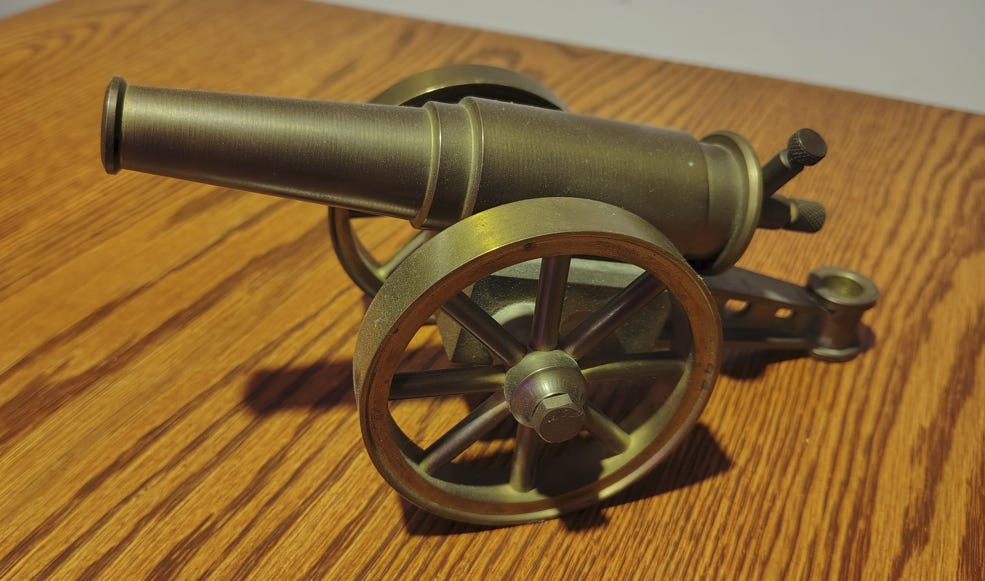
The rest of my college handiwork is too embarrassing to discuss, and shall never be mentioned in print. That toy brass cannon will be my legacy.
A few years after I graduated, while finishing a masters degree in applied physics for no real reason other than “why not”, I found myself immersed in the world of home studio recording. And of course, that too became as much about building stuff as recording stuff. I designed a nifty and rather large equipment rack on wheels. I’d show it to you, but smartphones didn’t exist and I didn’t own a camera back then. I wish I had a picture of it, as it was another masterpiece of form and function. It was six or seven feet high and housed two large semipro tape decks and a bunch of rack-mountable electronic gizmos. In a moment of temporary insanity, I traded it to a friend for two “Rockman” effects units. The Rockmans’ main claim to fame is that they make you sound like Boston — or more accurately, like Tom Scholz, their lead guitar player. Scholz was a fellow mechanical engineer from MIT; he invented the Rockman series. They’re the blue things in this photo:
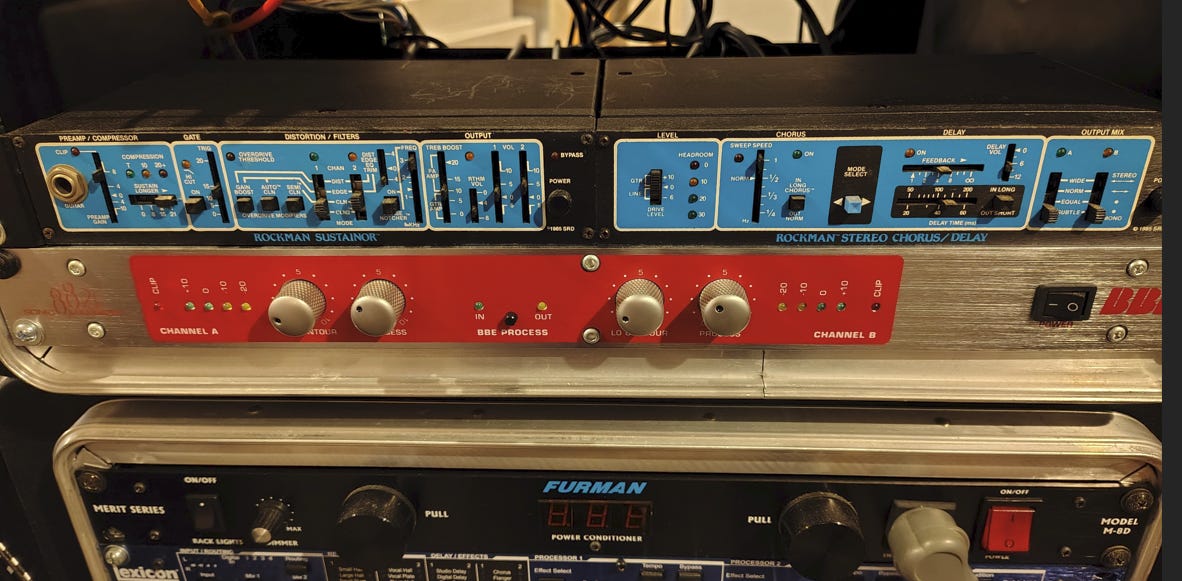
Mysteriously, original Rockman units remain in high demand to this day, having attained that oh so elusive moniker of “vintage”. So I’m sitting on a gold mine with those — feel free to make an offer, as I have no practical or emotional attachment …and, weirdly, the desire to sound like Boston has never taken root in my soul. Honestly, I’d prefer to have my priceless custom equipment rack back. I traded away part of myself in that deal. It was must-have infrastructure for a basement studio.
A couple years later I was producing products from said studio, one of which was a cassette (remember when rewinding was a thing?). I needed a store/office display, something that could hold a cassette tape and a brochure. This was my solution:
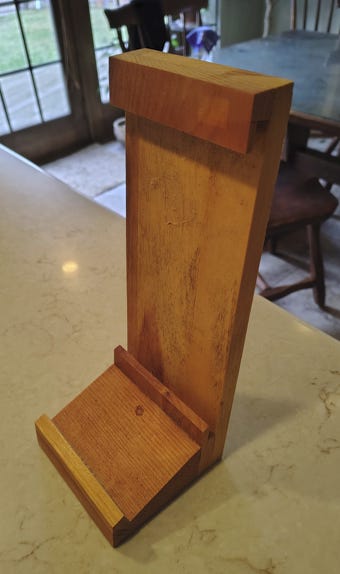
I designed it, but my brother — an Italian clone of that old German dude in the machine shop of toy cannon lore — kindly helped me refine the build process so that I could produce them in modest quantity in a basement (for mysterious reasons,, all of my best creative work must occur in garages or cold and gloomy basements ¯\_(ツ)_/¯ ).
Fun postscript: I discovered about half a dozen of them in a box a few weeks ago. Seeing no value, and with my youthful hoarding tendencies now dissolving like sugar in tea, they were headed to the trash. In one of those flashes of synchronous serenity that reeks of teleology, my daughter happened to be pulling into the driveway. I said, “Hey, I made these forty years ago, you want one?” She took two. A third is now in the kitchen. Why Tom, why? Well, as my daughter pointed out, they have broader potential. The artist in her immediately perceived a portable easel for smaller projects. But they also make great tablet holders. Thus, one has a new lease on life as a recipe display on the kitchen island. Here it is:
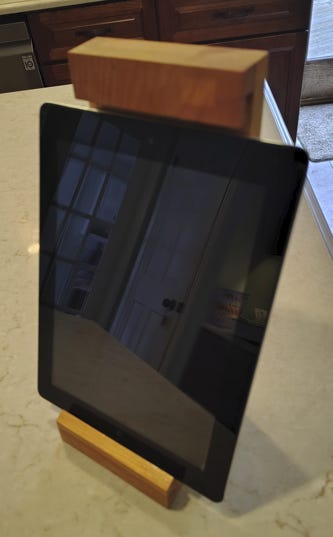
I had mostly given up on the old aphorism “if you build it they will come.” I’ve built a lot of stuff in my life, physical and digital. And in my experience, nobody comes. But this was the exception, even if it took forty years for the universe to reveal its true purpose. The cassettes are all in landfills, but their merchandising lives on, re-energized by circumstance. There’s a lesson in there somewhere.
I find a way to use most of what I learn. Someone should build a shrine to tinkering. Remember my three-sided clubhouse without a roof? Well, a few years after that first recording studio dissolved, a marriage and a house emerged in its place. And that house needed a shed. And decent sheds can be expensive. No worries — by this time, I had outgrown my willingness to acquire building materials the old-fashioned way (though, in a modest shout-out to the old days, I decided to skip the building permit). Instead, I made some sketches, drew up a list of materials, and ordered a bunch of lumber from Home Depot. At $900 (in 1994 dollars), I’m not sure that I saved any money vs. just buying a shed, but this was more about redemption at any cost. And can you put a price on quality?
At that point in my life I had not yet fully grasped the value of power tools, or a second set of hands. After all, I was the second set of hands growing up, and I might have confused myself with the helper I once was. Doh! — I hate it when that happens. So I built this shed by myself in the fall of ‘94, using a hammer and a standard-issue, crosscut wood saw:
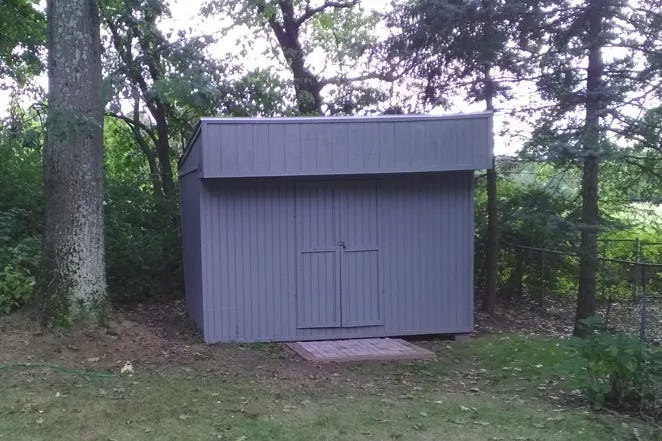
Honestly, that was dumb. Attaching that overhang by myself was a particularly neat trick. And I can’t say that a mechanical engineering degree helped much. But I managed. Three decades later, the shed stands. The current owners of the property recently completed a massive renovation / expansion of the main dwelling, but I am proud to report that the shed remains in its original form. In a way, I did get my clubhouse. But, as with the equipment rack, I sold my birthright for a bowl of stew. I want my shed back.
I have long since crossed into the TLDR abyss here, so I will share only two more examples, of the dozens in my repertoire. And then, maybe, we will see what it all means.
A few years after putting the finishing touches on that sweet shed, I found myself playing guitar in a praise band at church. On special occasions, the core band would expand into a small orchestra. Deep breath. Invariably, someone hands you an eight-page, self-indulgent orchestral arrangement of some three-chord song that doesn’t deserve the deluxe treatment, coolly ignoring the look of incredulity on your face as the resident deer in the headlights — er, guitar player. These are nightmare scenarios for the average guitar player who relies mostly on one-page chord sheets, and kinda just makes it up as s/he goes along anyway. Let’s not even worry about the fact that most guitar players can’t read music — most guitar players can’t even turn pages. And you can’t fit eight, or even six, pages on a music stand side by side.
After a few years of such indignities, I decided to fix this problem. Enter the StandExtender. It took some time and a few prototypes to find the geometric sweet spot, but here’s what I came up with — four feet of hinged polycarbonate bliss. Play the video to see it come to life:
You would be surprised at how useful that thing is for us non-page turners of the world. I think I still have a few left, if you want one. The scary part, given that the video is well into its second decade, is that I still own and wear that shirt.
So let’s fast forward to the present. I’ll skip a half dozen recent projects and showcase my latest bit of problem solving.
I use cheap cell phones. Go ahead, ridicule me. Yes, I should be embarrassed when I’m out with higher-end friends who won’t be seen with anything less than the latest Apple gadgetry. And I’m sitting there with my $200 Android that I bought five years ago. Well, I don’t see it that way. I say, “Air drop this, fella — if anything, you’re the one who should be embarrassed for dumping $1,500 on your covetous, jealousy-charged tech trip every year.” Anyway, I was very sad last year when my trusty LG Android, in otherwise outstanding condition despite its advanced years, stopped charging. The problem wasn’t the battery, although I’m sure it has seen better days. It’s the internal connector; the phone will charge only if you press the connector into the phone continually with some force (yes, I cleaned the connectors and did all the obvious troubleshooting — no luck).
Shockingly, I don’t enjoy jamming a USB connector into a phone by hand for three hours. I tried wrapping a rubber band around the connector and stretching the other end over the top of the phone. Close, but the connector deflects and the force vectors don’t line up well enough to create the requisite electrical connection. Undeterred, I devised this sexy little contraption to make everything line up:
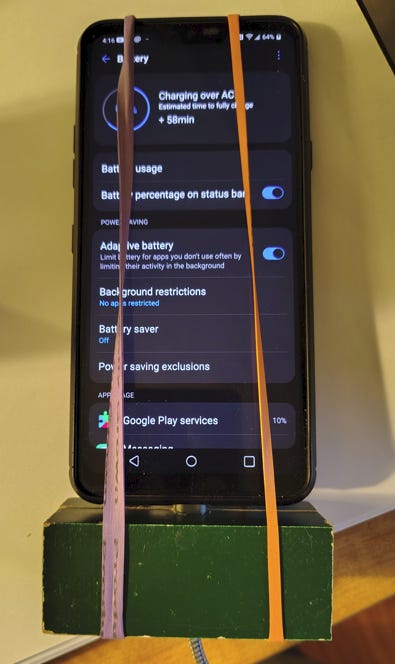
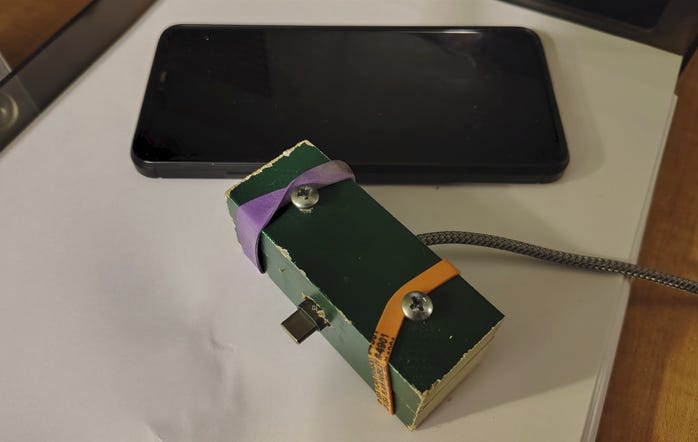
Basically, I embedded the cable securely in a block of wood. The geometry ensures that the rubber bands exert their force in the proper direction without deflection, and, yadda yadda… my trusty old phone lives, on a spare line that insulates my main phone from the wild.
I also get an unplanned bonus. When not using the block as a charger for my old phone, I keep it hooked to my computer as a data line for my primary phone. The block keeps the cable from falling all over the place when not in use, and I can just slide the phone in place when I need a file, without sharing it to some ambiguous cloud that wants to hang me on a display case for advertisers’ bidding. I used it a half dozen times just for this post. As I said, air drop this.
So what is this thing called edification? And why did I just write 3,500 words of playful background just to talk about it? Honest Answer: I like sharing personal stories and self-indulgent nostalgia, and a few of you seem to enjoy it. But my purpose is not entirely about that. Because edification is not entirely about building, despite its linguistic roots.
All civilizations build things. But the great ones also form institutions, generate knowledge, foster communities, and develop character in their people. Twenty years of online social networking point to a disturbing truth — something that history screams at us in all caps, albeit through a muffling veil of libertarian delusions, intellectual rot in the academy, and seventy years of lazy affluence. Humans like to tear down as much as they like to build up. When we take these things as symmetrical concepts, with roughly equivalent moral content, we miss the deeper distinction between building and edifying.
Build a block tower with a toddler and watch what the lovable little tyke does when you’re done (hint: they knock it down and giggle). Oh sure, it’s cute and harmless. But it is also symbolic and symptomatic. When humans have the opportunity to serve personal impulse and feelings, or tribal security, construction and destruction become two sides of the same coin. Either might do, as exigencies define the best catharsis. Maybe it’s a new iPhone. Or maybe it’s knocking down a tower of blocks.
When I wanted a clubhouse as a kid, I found a way to justify stealing wood to make it happen. It wasn’t about the edifice, or my own edification. It was about my will and desires. It never occurred to me that I would likely never use the clubhouse, nor did I have a club to host. I wanted what I wanted. I pursued a fantasy, reality be damned. Fortunately, it was mostly a harmless exercise. That it also taught me some construction basics was nice — my lifelong interest in creating things and processes to solve problems is a positive, as far as it goes. But building things to serve baser instincts is a black hole that will eventually eat communities and civilizations.
Of course, it is much easier to destroy than to build, to steal than to create. So it is no surprise that destruction and theft often win. If you welcome millions of people to an online platform that allows them to sort into tribes and express themselves for free, both monetarily and editorially, the result will be mass personal destruction. It will destroy reputations and supercharge dangerous dialectics for sure, but it will also destroy the souls of the destroyers. It doesn’t help that the host platforms turn dials behind the curtain to magnify the effects.
The 18th century British intellectual Edmund Burke was famously concerned about the effect that British policies in India might have, not only on the population of India, but on the character and national integrity of Britain and the British military, who were learning to normalize brutality and oppression. Burke was onto something. Our civilization is normalizing an array of destructive behaviors and ideas, and these are eroding our character and national integrity. We don’t want to admit this, and we sometimes encounter violent opposition to calling it out, because we are addicted. And addicts always protect their supply.
In contrast, edification is a form of love. 1 Corinthians 13 famously says:
Love is patient, love is kind. It does not envy, it does not boast, it is not proud. It does not dishonor others, it is not self-seeking, it is not easily angered, it keeps no record of wrongs. Love does not delight in evil but rejoices with the truth. It always protects, always trusts, always hopes, always perseveres.
Secular folks hear this chapter of the Bible most frequently at weddings. And that’s fine and appropriate. But the text itself has nothing to do with marriage. It is about the broader substance of human relationship, as it was intended by our Creator. Love protects, trusts, hopes and perseveres. These are the foundations of true human community.
Edification is a kind of emergent property that coalesces from these ingredients. Edification builds the environment, the medium, in which we thrive individually — and yet, paradoxically, requires that we actively set aside all of the edgy stuff that we falsely perceive as satisfying the irresistible demands of immediate will and desire. Once we find ourselves enmeshed in a true edification matrix, we discover that all of these individual needs are met (or disappear), and that our lives have infinitely more value, as we focus our lives on making it possible for others to do the same.
Western culture is in a frightening downward spiral. Most people I talk to recognize it. You can sense an unease. Sadly, most of those same people see the cause in some sort of us vs. them context, whether political, economic, sociological or religious. Just eliminate that particular evil, then everything will be okay, and we can all get on with our alienation and hyper individualism. And they miss the point. Humans cannot thrive outside of an edification matrix, something that gives us purpose, comfort and protection — not protection from outsiders, not from the “other”, not from the bogeyman, but from ourselves and our own selfish instincts. Once we free ourselves from our addiction to ourselves, we become free to build things that matter, for time and eternity. If we are to avoid the cultural implosion that history teaches is both inevitable and imminent, we must learn this one very basic lesson about who we are and why we are here.
A better economy won’t fix this. Tariffs won’t fix it. Clearing the land of immigrants certainly won’t fix it. Nor will obsessing about “kindness” in elementary schools, while promoting the hyper individualism that makes a true kindness regime impossible. Or force-fitting every social malady to racism or bigotry. Or draping every issue in new terminology to obscure the obvious truth. None of those things will address the underlying pathology. All are simply excuses that we believe will help us return to our desired goal of a hyper libertarian and perfectly equitable utopia. But that place doesn’t exist; there’s a choking, anti-human desert at the end of that rainbow, a place where the true human spirit goes to die. Fixing this will require restoring a holistic culture that understands what and who we are as humans. We thrive in a regime of true edification. Whether you like it or not, you are your brother’s keeper. Let’s start building.
Thanks for reading.